
I do not think we name the generosity of international life often enough.
You arrive, and somehow there is a place for you. Work. Community. Friendships that form faster than you would expect. Purpose that feels immediate. You are allowed to grow. And at the same time, there is an unspoken understanding you learn to live with. This soil is borrowed.
For more than two decades, my life unfolded far from where I was born and raised. I built a meaningful life, not in one place but many. I became an educator, a leader, a partner, a parent. I put down roots that mattered, even as those roots learned how to lift.
Living abroad teaches you to adapt quickly and belong efficiently. You connect deeply while knowing permanence is not part of the deal. You build systems and relationships you care about, fully aware that one day you will dismantle what you built, pack up what you can, and leave the rest behind for someone else to steward. It is simply the agreement. You may grow here, but not forever.
And then, sometimes quietly, you return.
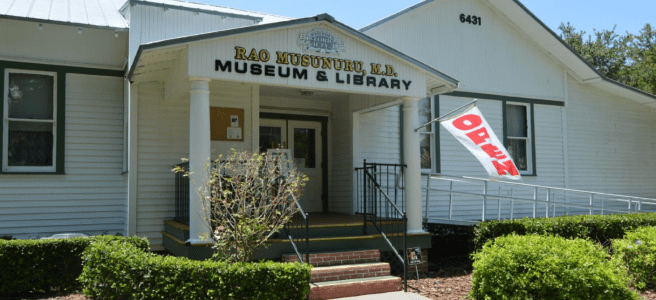
I have been back in my sweet hometown, New Port Richey, Florida… and recently started volunteering at the West Pasco Historical Society’s museum. The museum is housed in a schoolhouse built in early 1915. The floors creak when you walk, the good kind, the kind that lets you know you are not the first person to stand there. After a career spent in schools all over the world, I find myself back in one again. Smaller. Older. Much quieter.
On the surface, the work is modest. A few hours a week. Learning procedures. Researching. Asking where things go. I am new enough that I carry that polite uncertainty of someone trying to be helpful without getting in the way. Which, if we are being honest, is not my strongest skill set.
This week, a 103-year-old World War II veteran came in with his family.
They had flown south from Washington, D.C., escaping winter. This was not his hometown. His daughter told his story for him. He listened as she spoke, and he smiled. A big, gorgeous smile. He met my eyes in a way that made it clear he knew exactly where he was and exactly what was being said.
He listened.
I went back to greeting other visitors, the floor creaking under my steps, and kept thinking about that smile. In a museum full of local history, his presence reminded me that some stories stay, some travel, and some do both.
Volunteering has surprised me. Being in service has always been central to who I am, but for much of my career it came with titles, visibility, and outcomes. Service was easy to explain. This is different.
At the museum, no one is interested in my resume. I am being trained. Corrected kindly. After years of leading complex systems, I find myself genuinely content learning how to label things correctly and put them back where they belong.
It turns out I am perfectly happy being useful without being impressive.
There is something clarifying about that.
I am noticing how much identity lives in simply showing up. In listening. In contributing quietly to something that existed long before me and will continue without me. It is humbling in the best way. It is also, unexpectedly, a relief.
And it has me wondering, not urgently but honestly: who am I when I am not arriving or leaving? What does leadership look like when no one is watching or asking for it? What parts of me were shaped right here that I have been carrying across continents without realizing it?
Borrowed soil gave me so much. I am grateful for every place that allowed me to grow and learn. But there is something steady about standing where your story began and asking a simpler question.
How can I serve here?
Most days, the answer looks small. Opening the door. Greeting a visitor. Listening to a story. Walking across a creaky wooden floor in a schoolhouse that has seen far more than I ever will.
For now, that feels like enough.
I am showing up.
I am listening.
And I am letting the roots do what they are ready to do.
Dig deeper.
Author’s note:
If The Year I Stopped Trying to Be Impressive was about stepping away from titles and expectations, Borrowed Soil is about what I am stepping toward. Volunteering, listening, and returning to the place where my story began have helped me notice how identity shifts when achievement is no longer the measure. This reflection feels like the next honest chapter.


 prairielearning